

The Future of Design – My 5 Year Outlook
I’ve been thinking a lot lately about where our industry is heading. Between all the new AI tools, real-time renderers, and shifts in client expectations, it feels like we’re standing right at the edge of something big.
I’ve had countless conversations with other designers, tech nerds, and even a few clients who are starting to notice the changes. And after diving deep into the trends, testing a mountain of new software, and keeping my ear to the ground at industry events, here’s what I believe the next five years will hold for interior design, 3D modeling, and rendering.
Let’s start with where it all begins—interior design itself.
Key Takeaways:
- AI tools will streamline design tasks, but creativity and decision-making stay in the hands of designers.
- 3D modeling is getting faster and easier thanks to AI-generated assets and cloud collaboration.
- Mixed reality (VR/AR) is set to become a standard part of client presentations and walkthroughs.
Table of Contents
*Affiliate links may be used throughout this article. Read our Privacy Policy for more information.
Interior Design: Where Tech Meets Heart
AI won’t replace us—it’ll assist us.
That’s the biggest shift I see. Tools like ChatGPT, MidJourney, and concept generators are getting smarter. And soon, they’ll do more than just help with writing or creating pretty mood boards. We’re talking about AI that can pull together space plans based on client prompts, generate product selections with SKUs and specs, and even simulate how light and people move through a space.
But the key thing here? Designers still lead. These tools will be the assistant, not the artist.
Client experiences are going fully interactive.
No more static PDF boards or flat presentations. In the next few years, I think most clients will expect a 3D experience where they can explore their space in real time. They’ll click on finishes, swap out materials, and understand spatial relationships in a way that was once reserved for high-end commercial projects. This shift means designers need to be comfortable in tools like SketchUp, LayOut, and real-time presentation platforms that bring designs to life.
Sustainability will be built in—not tacked on.
Expect to see more platforms that let you filter materials by environmental impact, integrate with smart home systems, and provide transparency about where and how things are made. AI will help here, too, by guiding smarter sourcing and layout decisions that take daylighting, HVAC loads, and wellness into account.
3D Modeling: The End of Doing Everything the Hard Way
We’re about to say goodbye to 3D asset hunting.
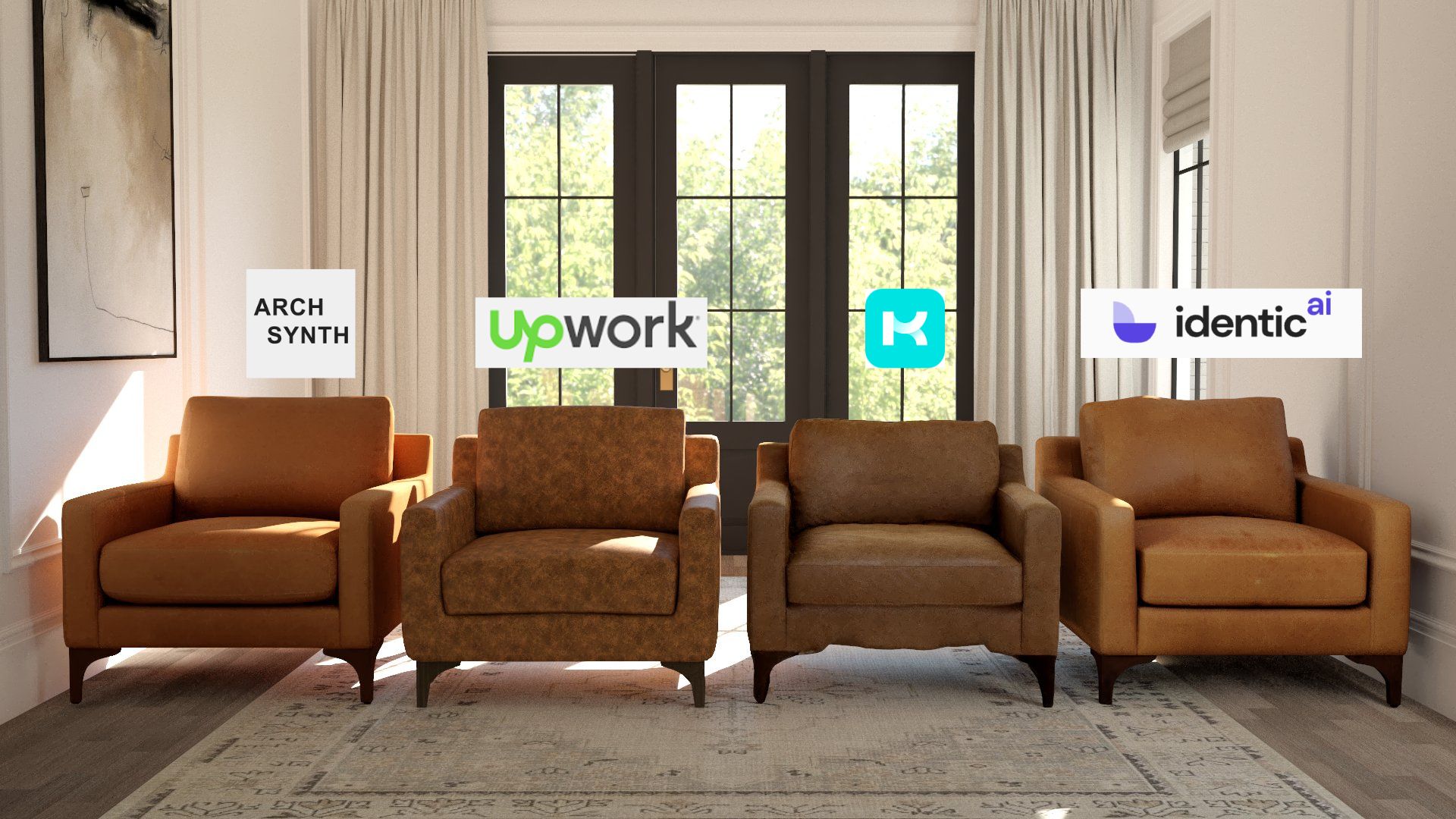
I used to spend hours trying to track down the right cabinet handle or armchair model. Now? We’re getting tools that can turn a single image into a usable 3D model. Platforms like Meshy and Identic are leading the way—and they’re only getting better. Imagine snapping a picture of a product and having a 3D version in your SketchUp model seconds later. That’s where we’re headed. Check out my blog post 7 Strategies for Sourcing and Creating 3D Components for a peek at how Identic AI created a chair model in 40 seconds for $0.14.
Cloud collaboration will be the new standard.
Designers, architects, clients, and trades will increasingly work together in real time, from different locations. No more waiting for marked-up PDFs. Everything will live in a shared 3D space where everyone sees the most current version. SketchUp’s Trimble Connect is already opening that door, and I expect others to follow suit.
And yes, automation is coming to modeling.
We’ll soon have tools that will automatically (and accurately) generate things like walls from a floorplan, cabinetry, lighting layouts, and even basic millwork details based on rules we set. That’s going to free us up to focus more on creativity and less on repetition.

Get My SketchUp Cheat Sheet!
A 2-sided PDF that you can print and reference as you learn and use SketchUp!
Brands Will Start Offering Their Products in 3D (Finally)
One of the biggest shifts I see coming—one that’s long overdue—is how product manufacturers will present their offerings online. In the next five years, expect to see more brands making their furniture, lighting, cabinetry, and décor available as fully downloadable 3D models.
We’re already seeing this trend start to pick up, but it’s going to snowball. Why? Because designers (and even DIY consumers) don’t want to guess how something will look in a space. We want to drop it into a model, scale it properly, apply real-world materials, and see exactly how it interacts with light and layout.
Here’s where I think we’ll see those models show up:
- Manufacturer websites will include 3D downloads alongside product images and specs—just like they already do with CAD files for architects.
- SketchUp’s 3D Warehouse will continue to grow as a hub for verified manufacturer content, especially as brands realize how powerful that visibility is.
- AR + Web-based configurators will allow users to place and customize products in real environments before buying—think IKEA’s app, but more refined and professional-grade.
- AI-powered tools – auto-generate 3D models from product photography and specs, helping smaller brands participate without massive design teams.
This will make life way easier for designers. No more wasting time modeling every chair leg or searching for close-enough replicas. We’ll be able to build faster, present more accurately, and make product-based decisions with real-world visuals.
For brands, it’s a win too. Getting your product into a designer’s 3D model is the modern version of getting into the sample library—it leads directly to spec sheets and sales.
Learn to Create These Renders in 7 Days
My 7-Day SketchUp Bootcamp for Interior Design will take you step-by-step from installing and configuring SketchUp, all the way to using V-Ray to create the photorealistic images you see below…all in 7 days!


Rendering: Real-Time, Realistic, and Emotional
Real-time rendering is going to be the default.
I’ve been watching this evolve in real time—literally. Render engines like Enscape, D5 Render, and Twinmotion are getting so fast and so good that the idea of waiting hours for a V-Ray render might become a thing of the past, at least for certain types of projects. As GPU technology advances and AI denoisers get even better, expect renders to be instant and stunning.

THINGS TO WATCH: V-Ray, which I’m an advocate for, is not a real-time renderer. Chaos has Vantage and now Enviz that does this, but I’m hoping in the next version of V-Ray, we will have a MUCH better version of V-Ray Vision and/or Interactive Rendering, which would be comparable to Enscape’s real-time view of a model.
We’ll be able to render using prompts.
Right now, in V-Ray (or whatever extension you use), we manually tweak exposure, white balance, and light positioning to get the right vibe. But in a few years, you’ll just type a prompt like “sunny spring morning in a rustic farmhouse,” and your renderer will apply the perfect HDRI, lighting temperature, and filters. It’s coming—and it’s going to let us tell better stories with our visuals.
Client-facing visuals will be more experiential.
No more showing still shots and crossing our fingers. We’ll be giving clients virtual walkthroughs in real time, guiding them through design decisions with photorealism and emotional impact. It’s not about being fancy—it’s about being clear and unforgettable.
Instant Animations with Simple Prompts
I also see a future where animations and fly-throughs are generated instantly, just by asking for them. Instead of manually setting up scenes, adjusting camera paths, and rendering each frame, you’ll simply prompt SketchUp or V-Ray using voice or text.
Imagine saying, “Create a 30-second fly-through of various scenes of this room for an Instagram post, fast-paced and engaging,” and within a minute, you have a ready-to-post video, complete with smooth transitions, optimal camera angles, and pacing tailored to your request.
This will open up incredible opportunities to quickly create high-impact content for clients and social media, without spending hours tweaking settings or editing footage. Designers will be able to generate multiple video styles on demand—whether it’s a quick walkthrough for Instagram, a cinematic reveal for YouTube, or a client-friendly presentation—simply by describing what they want.

Shop Laptops & Desktops for SketchUp
Download my FREE SketchUp and V-Ray Hardware Guide to get links to my recommended laptops for SketchUp!
Voice-Controlled Modeling is Coming
One of the most exciting developments I see coming in the next five years is voice-driven 3D modeling. Just like we can have conversations with ChatGPT today, I believe we’ll soon be able to talk directly to SketchUp and V-Ray—and they’ll understand not just language, but our design intent.
This future version of SketchUp and V-Ray won’t just respond to commands like “draw a rectangle,” it will have spatial awareness of the model, understand proportions, and know the difference between a kitchen, a bedroom, or an outdoor patio. It will have full access to your component library, instantly pulling in your favorite cabinets, light fixtures, or furniture on command.
Even more transformative will be the ability to generate custom components from pictures or descriptions. Imagine saying, “Create a custom arched doorway with a black matte finish,” and having it built right into your model—ready to be adjusted, rendered, or included in your documentation.
This AI-driven assistant will also manage your material libraries, choosing realistic PBR materials, applying them intelligently, and adjusting based on your design style.
And it won’t stop there: I believe these AI tools will ask us clarifying questions as we build. They’ll help spot inconsistencies, suggest optimizations, and collaborate with us—resulting in more accurate models, faster workflows, and higher-quality presentations.
This shift will make SketchUp and V-Ray even more accessible to designers of all levels and allow you to focus on creativity, while AI handles the technical heavy lifting. I’m already building my training programs to evolve alongside this trend.
AI-Driven Documentation Will Save Hours
Another massive shift I see coming is the transformation of how we produce documentation. Right now, creating professional design packets, elevations, take-offs, and client presentations can take just as long—if not longer—than building the 3D model. But I predict that LayOut will soon have a built-in AI assistant that changes everything.
I believe Trimble will train LayOut’s AI system on thousands of examples of design documentation—from concept boards to technical elevations to detailed take-offs. Instead of manually building every sheet, designers will simply describe what they need, and the AI will automatically create clean, professional documents in minutes.
Even better, this AI will be trainable to your personal brand style guide. You’ll be able to upload your preferred fonts, colors, layouts, and design preferences, and LayOut will output documentation that looks like it came from your studio—not from a cookie-cutter template.
And because it’s conversational, you’ll be able to ask for revisions or refinements on the fly. Want to add a custom title block? Done. Need to show a specific elevation with call-outs? Just ask. Want to generate a fixture schedule or a materials list? The AI will pull it directly from your model data and produce it for you—saving you hours of tedious work while making your documentation more consistent and client-friendly.
Need to translate it to Spanish for your contractor’s? No problem, multi-language translations will take seconds to create.
This AI-powered documentation will free designers to focus on creativity and high-level design decisions, while the time-consuming grunt work gets handled faster and more accurately than ever before.
Bonus Prediction: The Mixed Reality Tipping Point
This might sound bold, but I truly believe mixed reality—VR and AR—will become part of our standard design process in the next five years. Tools like Apple Vision Pro and Meta’s upcoming platforms are going to normalize the idea of putting on a headset to walk through your new kitchen, living room, or backyard.
Designers who get comfortable with this now—learning how to model and render with VR in mind—are going to be way ahead when clients start asking for immersive presentations.
So What Does This Mean for Us?
We’re not being replaced. We’re being upgraded.
Yes, it’ll take some learning. Yes, some of it might feel overwhelming at first. But these changes are all working in our favor—as long as we lean in, adapt, and keep learning.
If you’re a designer wondering where to focus next, here’s where I’d start:
- Learn to model cleanly and efficiently in SketchUp. My Bootcamps are a great place to start.
- Get familiar with at least one real-time rendering tool.
- Start experimenting with AI tools like MidJourney or ChatGPT for design support. My course FOCUSED Ai For Designers will get you up to speed quickly!
- Keep an eye on VR platforms—and maybe even dip a toe in with basic walkthroughs. My FOCUSED Virtual Tours & Virtual Reality will get you trained on this.
This isn’t the future of design. It’s the present knocking on the door, asking if you’re ready.
And personally? I am.
Frequently Asked Questions
Nope! AI will assist designers, not replace them. Think of it as a superpower that helps with research, mood boards, layouts, and more—while you stay in charge of the creative vision and client relationships.
Short answer: yes. But don’t worry—it’s more approachable than ever. Learning tools like SketchUp, V-Ray, and a real-time renderer (like Enscape or D5) will put you ahead of the curve.
Very likely. As headsets get lighter and more affordable, clients will expect to "walk through" their spaces. Designers who learn how to create immersive experiences now will be ready when that moment arrives.
Start small. Try using ChatGPT for client emails, MidJourney for mood board concepts, or tools like Meshy to test 3D model generation from product images. You don’t need to go all-in overnight—just start playing and learning.

Ready to Learn SketchUp?
Check out my SketchUp & V-Ray courses to find the right one for your skillset and your design specialty. Online, self-paced, and lifetime access!
Tags